

Welcome to the Fork in the Road Blog: Reflections on Life. These musings, reflecting on life’s “What”, “Why?” and “How?”, are for my mental wellbeing. The topics come to me haphazardly triggered by the surroundings or interaction with people or purely out of the blue.
This topic came to me while on holiday in Serengeti game park in Tanzania being driven in an extensively flat and open area with dotted trees and not much landmarks for direction. One could see the horizon in all directions with criss-crossing vehicular tracks. I thought to myself that one must have a sense of direction to find one’s way in such a setting. My wife and I saw a lot of animals and, thanks to our driver/guide, arrived back to our hotel.
A sense of direction is the capacity to know where you are, where you want to go, and how to get there. It helps you find your way from one physical place to another. At a deeper level, however, sense of direction is a powerful metaphor for how to navigate life.
The physical sense of direction enables us to orient ourselves using landmarks, maps, memory and the ubiquitous digital navigation applications (Apps) in telephones.
Knowing the direction you are facing, is not the same as knowing where you are going. A compass can tell us that we are facing north but it cannot tell us whether our destination is northwards.
Someone may have an excellent natural sense of direction and is rarely lost. Another may become disoriented and easily lost in what may seem like a local environment. Irrespective of whether one has a sense of direction or not, one needs to know the destination before deciding which way to go.
Sense of direction as a metaphor refers to something deeper: a personal life purpose, life orientation and movement toward something meaningful.
A person with a sense of direction may not have every detail of life worked out, but would know what they want, what matters to them, what they are trying to achieve, what they stand for, what they should follow, what they should avoid or what kind of person they want to become etc. A life’s sense of direction is not necessarily a rigid life plan.
Direction is connected to destination, but they are not the same. I touch on these concepts in my book “A view round the bend. Setting goals for your life’s journey”. A young person may be referred to as having a sense of direction in life by giving a precise life’s goal (destination): I want to become a doctor; or a broader goal: I want my life to be devoted to healing and serving others. The latter may allow for unexpected roads and opportunities without losing one’s orientation.
We cannot meaningfully speak about direction without some point of reference whether in the physical sense or metaphorical meaning. In a physical journey, we might say: “I am going south-east.” But this statement will be meaningful only to people who have a mental compass orientation. A better statement could be “I am going towards town A past the sugar factory”.
In the metaphorical meaning, our reference points may be family, community, moral principles, professional aspirations, a sense of responsibility etc
For example:
- Family as an anchor: “My family keeps me grounded when life becomes uncertain.”
- Moral principles as a path: “Honesty and fairness guide the road I choose.”
- Community as a compass: “The needs of my community point me toward service and cooperation.”
- Professional aspirations as a destination: “Becoming a skilled teacher is what I am working toward.”
- Responsibility as a guiding light: “My responsibilities remind me which direction to take when decisions are difficult.”
When musing over sense of direction, I cannot help reflecting on how modern life places enormous emphasis on speed, sometimes speeding to nowhere. As we sat in the vehicle in Serengeti the guide-driver zooming in this landscape with no directional markings, I felt asking him, “Where are we rushing to?”
Although we had achieved our objectives of seeing large varieties of wild animals, I feared that we may end up lost in the wildness. Speed was not what we wanted but facing in the right direction back to the hotel. A thought crossed my mind that the fastest person on the wrong road is still going in the wrong direction.
It is easy to lose one’s sense of direction because of circumstances. For example, due to social issues such as bereavement, economic hardship, career or relationship changes. These can make the familiar map of life unreliable.
At such moments we may have to redefine our direction by answering the question: “Which direction should I take given all that has happened?” This is in line with what I wrote in my book Fork in the Road: Creating a future of value starting from where you are
One of the more subtle problems in life is that we can be easily misdirected by other people. It is easy to assume a sense of direction from other people, mistaking wrong information for guidance or mentoring.
There is also a danger of conceded direction. We may pursue a career because our parents wanted it. We may adopt ambitions because everyone around us appears to have them. We may seek wealth or status, at any cost, because society equates wealth and status with success.
This does not mean that other people’s advice is unimportant. Families, mentors, traditions and communities can provide valuable guidance. But ultimately, each person must take responsibility for the direction of his or her own life.
We can therefore spend years moving in what we may have thought to be the right direction only to discover that we were following somebody else’s compass.
Direction chosen intentionally is purpose; direction inherited unquestioningly can become conformity.
There is a strong connection between sense of direction and choice.
Every journey, physical or life’s virtual, presents choices: take this turn or the next; take the familiar choice or explore existing alternatives etc. What we perceive as sense of direction is based on decisions and choices we make, as elaborated in my musing on Choices.
The daily choices about how we spend our time, whom we trust, what we learn, what we ignore, what we value and how we treat others gradually establish the direction of our lives.
Having a sense of direction comes with the ability to make the right decisions to change course depending on circumstances.
Changing direction can be a sign of wisdom rather than failure. A person may begin with a career that seems promising but discover a better one in due course. A business may change its strategy. An honest leader may realise that an earlier decision was based on wrong assumptions and change the direction of his leadership. A person may discover that a lifestyle once considered important no longer has meaning.
The issue is not whether we change directions but whether we know why we are changing and not merely adrift.
Perhaps one of the greatest misconceptions about having a sense of direction is that it requires certainty. It does not. We often must move forward without knowing exactly what lies ahead.
A sense of direction therefore provides orientation without necessarily providing certainty.
In life’s direction, for example, it may be “I don’t know exactly what my future holds, but I know I want it to involve learning, service, integrity and meaningful relationships.” That is already a sense of direction.
There are subtle differences among the three concepts of direction, purpose and significance or meaning.
A person can have direction without much purpose, simply pursuing an objective. One can have purpose without knowing how to achieve it. The productive sense of direction requires a combination of direction, purpose and significance.
Sense of direction is not limited to individuals. Families, organisations, communities and countries also need the right sense of direction.
A family may ask: “Is the family acting as a unit for the good of all members?” An organisation may ask: “Do we have the correct strategies to achieve our goals?” A country may ask: “Is the country being governed with respect to human rights and social accountability?” This is particularly currently relevant.
The question is not merely “What are we doing or how is the country led?” but: “Are what we are doing, and the manner in which the country is led, taking us toward the kind of society we want to be?”
There is a difference between being lost and losing one’s sense of direction.
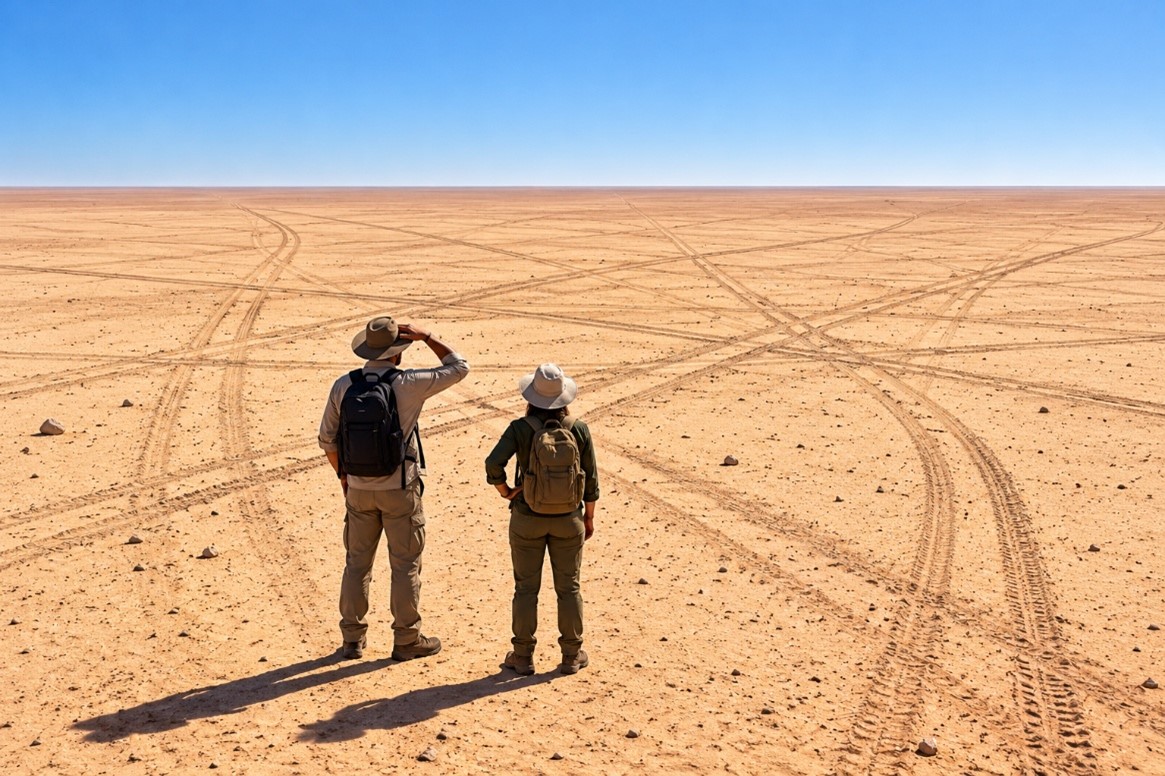
Being lost may simply mean that we do not know where we are, physically or metaphorically. Losing direction can mean something deeper that we no longer know where we want to go. The first problem can often be solved with a physical or social life map. The second may require reflection to reassess the destination.
A useful way of thinking about the sense of direction compass, physical or virtual life, is through five questions:
- Where do I want to go? — my aspirations.
- Why do I want to go there? — my purpose and values.
- Where am I? — an honest assessment of my present circumstances.
- What is the next step? — translating intention into action.
- How will I know whether I am still on course? — reflection and correction.
These questions turn sense of direction from an abstract idea to an actionable exercise.
Perhaps the deepest lesson about sense of direction is that life is not simply about getting somewhere. It is about knowing what kind of journey we are undertaking.
We may not control the life’s obstacles. Sometimes we may even have to stop and ask for directions. But we can still ask ourselves:
- What is my compass, my reference points?
- What is my destination?
- What guides my choices of direction?
- Am I moving by my free will, or being moved or adrift?
- And when I reach where I am going, will it be my intended destination?
A sense of direction, therefore, is not simply knowing which way to go. It is the deeper capacity to connect where we are, where we are going, why we are going there, and for the life’s sense of direction, who we are becoming along the way.
This raises a profound question. What is your life’s compass for your life’ sense of direction?
Thank you for being part of the Fork in the Road Blog: Reflections on Life. Be sure to look out for the next episode when I will be writing about Bedside manners. If you gathered something useful, please feel free to share the blog. My books, Fork in the Road: Creating a future of value starting from where you are and A view round the bend. Setting goals for your life’s journey are available for purchase at Aristoc bookshops in Kampala, Uganda and online at Amazon.
Your comments on my musings are most welcome and let me know whether there is a topic you would like me to muse over.
1 Comment
Jason Dungu
Thank you for sharing your wise musings. One must always have a sense of direction, even if the final destination or outcome is uncertain