
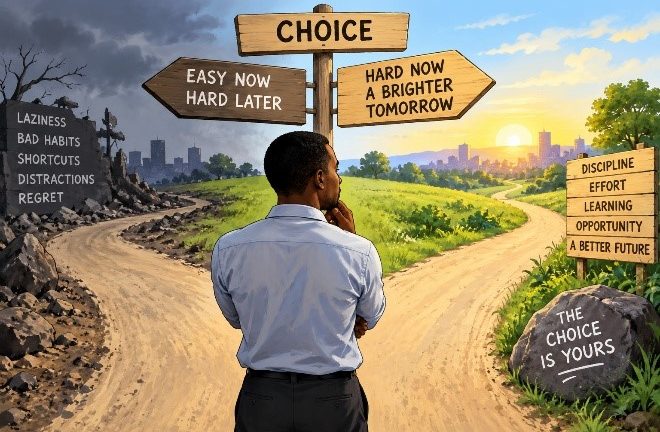
Welcome to the Fork in the Road Blog: Reflections on Life. These musings, reflecting on life’s “What”, “Why?” and “How?”, are for my mental wellbeing. The topics come to me haphazardly triggered by the surroundings or interaction with people or purely out of the blue.
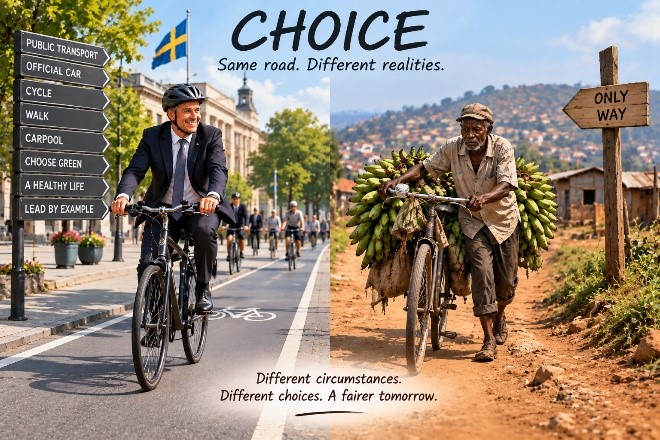
In the blog on “If”, I muse over conditional decisions in life, without invoking the word “choice”. Then I saw a TV news item of a Scandinavian country prime minister cycling from his swearing-in ceremony instead of being driven in an official transport vehicle. My over-active mind zeroed in on the choices we make. The PM chose to ride a bicycle like many other people in the city in that country. I then remembered an old man I meet regularly pushing an old bicycle loaded with bunches of bananas. That old man has no choice for a better mode of transport.
Choice is selecting a possibility from among alternatives that are perceived to be available. This is decision making I wrote about in my book “Fork in the road. Creating a future of value starting from where you are”.
For something to be called a choice there must be alternatives or possibilities, a chooser or someone reacting to the possibilities and a selection. Choices become much more interesting when we explore the kind of choices we make and what drives their selection. For example, at the basic level, if you choose whether to wear a light blue or maroon dress, the alternatives are wearing a light blue dress or maroon dress, you consider them and you choose one.
“Choice” is one of those concepts that invokes freedom (freedom of choice), thought (thinking about the process), desire (wanting to make a choice), values (the benefit(s) of making a choice), circumstance (the setting and conditions of the selection), and action (the eventual choice making).
Existence of a choice does not necessarily mean unrestricted freedom. Social and physical circumstances and lack of information can greatly impact on the choice-making process. Circumstances could even be obliterating, eliminating the apparent choices.
Trying to understand the choices we make, we can classify them along several dimensions.
| Dimension | Types of choice | Example |
| a) Basis | Rational / Emotional / Intuitive / Habitual | Calculating an investment /. giving money to a street beggar / following one’s instinct / getting out of bed every morning to go to work |
| b) Beneficiary | Self / Others / Collective | Buying something for oneself /. buying birthday gifts / donating to an orphanage |
| c) Consciousness | Deliberate / Automatic | Choosing a career /. reaching for your phone when it rings |
| d) Consequence | Reversible / Irreversible | Selecting a shirt to wear /. undergoing major surgery |
| e) Domain | Personal / Social / Economic / Moral / Political / Spiritual | Exercise, / friendship, / investment, / lying, / voting, /faith |
| f) Ethical character | Neutral / Beneficial / Harmful / Moral dilemma | Abstention / deciding to assist a needy child / blocking freedom of passage of an ambulance / deciding whether to betray someone |
| g) Freedom | Free / Constrained / Forced | Choosing a shirt to wear /. Buying half a litre of milk for lack of money / handing over your wallet to a street robber |
| h) Importance | Minor / Significant and life-changing | Which shirt to wear /. whether to migrate or not |
| i) Knowledge | Informed / Partially informed / Ignorant | Evidence-based choice / choosing based on hearsay / choosing without knowing the issues involved |
| j) Time horizon | Immediate / Short-term / Long-term | What to eat /. which friend to visit over the weekend /. what profession to pursue |
The most fundamental distinction among the choices we make is the kind of thing we are choosing, whether it is for action “What shall I do?” or inaction “What shall I refrain from doing?” where doing nothing can itself be a choice or even inaction being informed by the reasons for the choice. We also make choices based on a value scale of importance. For example: comparing monetary value and time saving, or security and fun. Often our character is formed by the deliberate repeated choice we make, to be honest or dishonest, generous or tightfisted, courageous or cowardly, humble or arrogant etc. These are choices of identity.
Therefore, the choices we make can be used to assess our behaviour. A desirous behaviour would be reflected in choices made “because I want it” while a timid behaviour would be associated with choices made “because I am afraid of the alternative.” Habit-based choice is made “because that is what I normally do” etc. A choice can belong to several categories simultaneously. For example, “I choose item ‘A’ on the menu not only because I like it, but because that is what I always select at this restaurant and I am comfortable with it”.
There is the distinction between choice and decision. Choice refers to selection among alternatives while decision points out the conclusion reached after reflection. Choice therefore describes the possibility and act of selecting, while decision describes the outcome of consideration.
Another important distinction is between choice and preference. Preference is what we desire; choice is what we select dictated by the circumstances. You might prefer to stay within 5 kilometres of your workplace in the city centre but choose to rent accommodation in the suburb because you cannot afford the city rents. Choice sits between preference and action. “What I decide” sits between “what I like” and “what I do” with circumstances intervening at each stage.
The concept of choice becomes philosophical when freedom is invoked. If you needed income to take care of your family and you choose to work in any available job, would that be a free choice if there was no other option? We can therefore distinguish free choice, where meaningful alternatives exist and restrained choice, where whatever alternatives might exist are restricted. There are also forced choices, where someone is compelled by threat or force, and no choice, when there is effectively no meaningful alternative. Under this scale, choice is not binary but best understood as existing along a continuum of freedom.
A useful framework when looking at choice as a major human concept is to consider it according to hierarchy. I found six levels. Level 1: survival choices such as food, shelter, safety, health. Level 2: practicality: education, employment, money, transport, housing. Level 3 relationship: family, friendship, marriage, community. Level 4 aspirational: career, wealth, achievement, creativity. Level 5: morality: justice, honesty, responsibility, sacrifice. Level 6 existential: connecting choice with character, purpose and meaning.
A few more words about Level 6, without getting into deep philosophical waters. Existential choices are perhaps the deepest choices human beings make. As I have educated myself for this musing, I accept them to be a response to the question:
“Given the circumstances into which I have been placed, the abilities and limitations I possess, the people with whom I share this world, and the limited time available to me, what kind of person will I choose to be, and what will I choose to do with my life?” Putting it slightly differently, the question may be phrased as: “What kind of person shall I be, and what shall my life mean?” This goes beyond choosing what to do, to choosing, consciously or gradually, how to live. An existential choice is therefore not simply: “What should I do?” but rather: “Who am I becoming through what I do?” and ultimately: “What makes my life worth living?”
That question brings motivation and cleverness, topics I have already mused over, together with responsibility, character, service and meaning in a single framework with choice.
I came across a statement that “We make choices, but our choices also make us” illustrated by an example of telling the truth. Choosing to tell the truth may have an immediate cost. It may have a future consequence for a relationship. But repeatedly choosing honesty can also contribute to one’s character. Choices may, therefore, be viewed as having at least three consequences: immediate consequence, future consequence and character consequence
Finally, human choices may be conceptualized as a framework presenting human choice as a continuous, conscious or subconscious, cycle rather than a single decision, as follows:

We begin with conditions, identify possible options, and interpret them through our perception. Our desires and principles determine what matters, while consideration evaluates the alternatives before we make a choice and translate it into action. Actions produce results, intended or unintended, from which we learn. That learning changes our knowledge, values, perceptions and expectations, influencing future choices.
Thus, choices both respond to circumstances or conditions and create new ones. Ultimately, we make choices, and our choices help make the person we become. The chain is influenced by emotion, instinct, habit, social pressure, knowledge, memory and unconscious influences.
This also connects with my musings over cleverness and motivation: motivation helps explain why we want one alternative rather than another; cleverness can influence how effectively we evaluate and exploit the alternatives; and choice is the point at which one possibility is selected.
In that sense, we can say that Motivation answers: “Why do I want this?”, Cleverness answers: “How can I get it?” and Choice answers: “Which path will I take?”.
The Scandinavian country prime minister and the old man both fit into this conceptual framework but with very different influences.
Thank you for being part of the Fork in the Road Blog: Reflections on Life. Be sure to look out for the next episode when I will be writing about Sense of direction. If you gathered something useful, please feel free to share the blog. My books, Fork in the Road: Creating a future of value starting from where you are and A view round the bend. Setting goals for your life’s journey are available for purchase at Aristoc bookshops in Kampala, Uganda and online at Amazon.
Your comments on my musings are most welcome and let me know whether there is a topic you would like me to muse over.
1 Comment
David Kasingwire
Thank you PP Stephen. Reading this has reminded me that irrespective of who you are, the choices you make depend on many other factors around us and we have no control over those factors. For example, one is forced to put on a very uncomfortable suit on a very hot day because of wanting to fit in and this is not his choice but a choice forced upon him by the circumstances. To me no body has choice. One is Rich because he is either lucky or, bright, hardworking but behind all this background matters. It’s the same for a poor person and even if you avail capital to them, they remain poor.