

Welcome to the Fork in the Road Blog: Reflections on Life. These are “fireside” musings on the reasonably long life I have lived so far. It is my way of thinking aloud over everyday issues, reflecting on life’s “What”, “Why?” and “How?” and sharing my views with people around me, physically and virtually. The musings are, however, primarily for my wellbeing. They are therapeutic. They keep me mentally alive. The topics I muse over come to me haphazardly triggered by the surroundings or interaction with people or purely out of the blue.
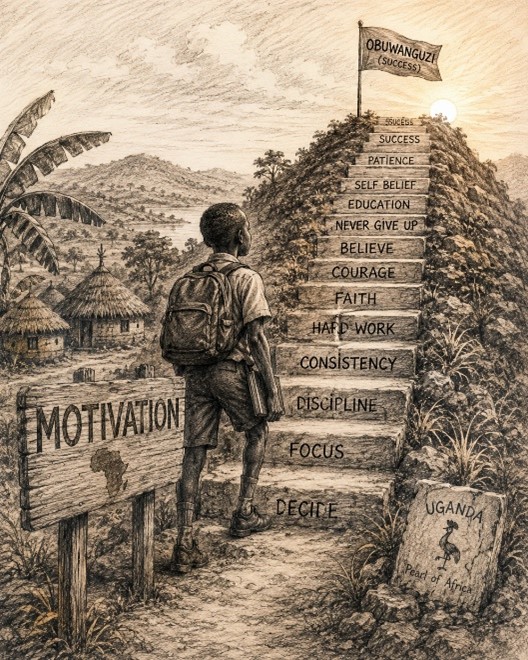
Motivation can be described as the inner drive, desire, purpose, or force that moves a person to act, persevere, and pursue goals. It is what gives energy and direction to human behaviour. Motivation may be from within (intrinsic), doing something because it is meaningful or enjoyable, due to desire, values, ambition, faith, curiosity, or personal satisfaction. It may also be driven by external forces (extrinsic), doing something because of rewards, approval, or consequences driven by recognition, fear, pressure, or encouragement from others. Decisions we make in everyday life are consequences of motivation in ways we hardly notice.
I am not venturing into the scientific physiological or psychological studies or philosophical aspects of motivation.
Motivation hit my wandering mind when I started noticing relatively privileged, young people sitting at home waiting for someone to look for work for them. Some of these are my relatives and I was concerned by their lack of motivation for employment. Most of those I offered a hand, out of compassion, were not reciprocating with the effort given to pull them up. They expected me to do all the weightlifting: write their CVs, look for potential employers and have jobs arranged. In the Hooks and Ladders musing I said that giving a helping hand to some in need not only benefits the person being helped but also gives the helper a sense of fulfilment and satisfaction. Lack of motivation by the people I tried to help unfortunately moved me to a sense of total dissatisfaction.
Motivation influences our daily actions whether to wake up early, go to work, study, pray, exercise, look for employment, help others or abandon responsibilities etc. Even simple acts like cooking, cleaning, or interacting with people are often shaped by some form of motivation.
Motivation affects temperament and attitude. Strong positive motivation can create enthusiasm, optimism and resilience. Negative or unhealthy motivation such as greed, envy, fear, or excessive competition, may produce unethical behaviour.
I believe that concepts of innovation, leadership, entrepreneurship, and personal development all depend heavily on motivation. Together, they form a powerful framework for individual and organizational growth. Personal development strengthens the individual, leadership influences others, entrepreneurship creates opportunities, and innovation drives progress.
Talented people without motivation may accomplish little, while moderately gifted but highly motivated people often achieve remarkable results. Lack of motivation often leads to procrastination, withdrawal, or giving up easily.
Our motivations matter morally as much as our actions. Two people may do the same good deed for very different reasons, compassion, publicity, guilt, duty, or personal gain. Institutions and organizations often reflect the motivation level of those leading them. When leaders lack motivation, vision, or moral purpose, institutions can stagnate. A person, especially a young person, who lacks motivation may become more susceptible to increased vulnerability to negative influences such as harmful peer pressure, exploitation or destructive habits.

Communities depend on people being motivated to serve, organize, volunteer, lead, and cooperate. When motivation declines in a society, civic engagement weakens, public responsibility declines, and institutions suffer. Organizations such as Rotary rely on motivated volunteers who are driven by a desire for service, fellowship, and shared responsibility.
We are normally motivated by felt need. A need for a job, for food, for companionship, for love etc. Job seeking is one of the clearest practical expressions of motivation. People seek jobs because they are motivated by survival, family responsibilities, desire to use their talents meaningfully, personal growth, etc. A motivated job seeker is more likely to prepare applications carefully, persist despite rejection, be boosted by any support provided, adapt to changing opportunities, etc. In countries with youthful populations such as Uganda, motivation is especially important because many young people face intense competition for limited formal employment. When motivation is lacking the situation like the one I have touched on develops among young, privileged people waiting for jobs to come to them.
Hunger, both physical and symbolic, is one of the most basic human motivators. Physical hunger motivates people to seek food, work or survival opportunities. A hungry person is often compelled to act because survival is at stake. Food insecurity can lead to economic hardship pushing people into activities they would not have taken as their first choice.
Symbolic hunger for security, recognition, love, good governance or dignity can be a motivator for civil public expression of the need to correct the situation, or for an individual to “go out” to socialize and meet other people.
Ambition is a higher-level form of motivation directed toward achievement, success, influence, or excellence. A motivated person may study harder, innovate, lead, or sacrifice comfort in pursuit of long-term goals. Ambition often grows from personal aspirations, social expectations, the wish to improve one’s family or community, competition, desire for recognition etc.
A healthy ambition can encourage discipline and perseverance, inspire creativity and leadership. Ambition can also become negative leading to greed, corruption, unhealthy competition, and unprincipled decisions. Motivation and ambition are ideally judged by service, integrity, and concern for others in the manner of Rotary.
Motivation is generally seen as positive, but it can become excessive, unhealthy, or misdirected. Over-motivation can produce harmful personal, social, moral, and even physical consequences when ambition, drive, or enthusiasm lose balance, restraint, or wisdom. A person who is excessively driven for example by work (workaholic) may neglect family, personal well-being or generally lose contact with the world beyond his/her work.
Motivation can become unhealthy when achievement becomes the sole measure of significance. This may lead to ethical compromise toward corruption, manipulation, dishonesty, or exploitation with the end justifying the means. A person may sacrifice relationships or ethics in pursuit of recognition, wealth, or status. Political ambition may make a leader sacrifice decency for entrenchment in a leadership position. or become authoritarian. Religious zeal may become intolerance, business ambition may become exploitation, academic pressure may encourage cheating.
Over-motivated individuals may unintentionally dominate others, become impatient, or neglect communal responsibilities. Family members and colleagues may feel used, ignored, or pressured.
Over-motivation can lead to loss of inner balance. Some people become so driven by productivity or achievement that they lose a sense of meaning, peace, or contentment. Life becomes a constant chase for “more”: more money, more recognition, more influence, more accomplishments. This can create inner emptiness despite outward appearance of success.
Healthy motivation is guided by positive values, respect of others, ethics and connected to purpose rather than mere achievement. Motivation is like fire: too little may leave life stagnant, but too much, or misdirected, can be destructive. The challenge is not merely to be motivated, but to be motivated wisely, ethically, and in balance with human dignity, relationships, and the common good.
While lack of motivation and depression are not always the same, yet depression is commonly linked to a loss or reduction of motivation when activities which once felt meaningful, enjoyable, or worthwhile begin to feel exhausting, empty, or pointless. Energy levels drop, interest and pleasure in work, hobbies and human interaction are lost with a general sense of hopelessness.
We all experience temporary lack of motivation without being depressed. This can be due to tiredness, tension, boredom, discouragement, disappointment etc. The situation changes with time and circumstances and we recover our normal motivation.
Depression is different because the manifestation of motivation is often persistent, deeper, harder to overcome by willpower alone and accompanied by other symptoms such as despair, emptiness, irritability, sleep and appetite changes, a feeling of hopelessness leading to social withdrawal.
The connection between motivation and depression can be cyclical: Depression reducing motivation, reduced motivation leading to inactivity or isolation. Inactivity worsening feelings of failure, loneliness, or hopelessness, deepening depression further. These signs may trigger a need for professional care and support.
Persistent lack of motivation can have significant social consequences, both for individuals and for communities. Because motivation affects participation, responsibility, productivity, and relationships, its absence often extends beyond the individual when the issues relate to family, workplaces, institutions and society at large.
Motivation is not merely a private feeling; it has social power. Motivated individuals often inspire others, strengthen institutions, and contribute to the common good. Conversely, widespread lack of motivation can weaken families, organizations, and societies. A society functions best when motivation is guided not only by personal gain, but also by ethics, dignity, opportunity, and concern for the common good.
Motivation is like the unseen engine behind human conduct. It can elevate people toward discipline, compassion, and service, or push them toward selfishness and destructive behaviour. Understanding what motivates us helps us live more intentionally and ethically
Thank you for being part of the Fork in the Road Blogs: Reflections on Life. Be sure to look out for the next episode when I will be writing about Flowers. If you gathered something useful, please feel free to share the blog. My books, Fork in the Road: Creating a future of value starting from where you are and A view round the bend. Setting goals for your life’s journey are available for purchase at Aristoc bookshops in Kampala, Uganda and online at Amazon.
Your comments on my musings are most welcome and let me know whether there is a topic you would like me to muse over.
Comments (6)
Muniini K. Mulera
Excellent! I read this blog to my daughter, who is a psychologist. “It is very well done and very clear”, my daughter said. “I am inspired,” she added.
Stephen Lwanga
Thanks, Muniini, I am uplifted by your daughter’s comments. This issue hit me hard when I responded to a call to help a relative’s child find a job only to discover that the child was sitting at home waiting for people to find the job. The child was not even bothered to prepare a presentable CV!
Keep motivating the young people. The future is in their hands.
Immie Bukko
Inspirational and good guidance on how to use our energy.
Stephen Lwanga
Thank you Maama Mupeera. Let us continue to inspire each other and those ready and willing to be guided.
Joseph Tinka
Thank you SL for the great insights on this complex phenomenon.
You mentioned that ‘Motivation can be described as the inner drive, desire, ……….that moves a person to act…….’
Is amotivation therefore driven by motivation, or is it a lack of motivation? Does one have a motive for being amotivated?
Secondly, to what extent is motivation innate?
Stephen Lwanga
Thanks, Tinka, for the comments. I believe there must be a “motive” to be motivated. Just as there must be a “destination” for move or journey. a destination may be wrong or inappropriate, but it informs the journey, similarly one can be motivated by the wrong motive. I touch on this in the blog. Motivation is not seen but demonstrated by actions, behaviour etc..