
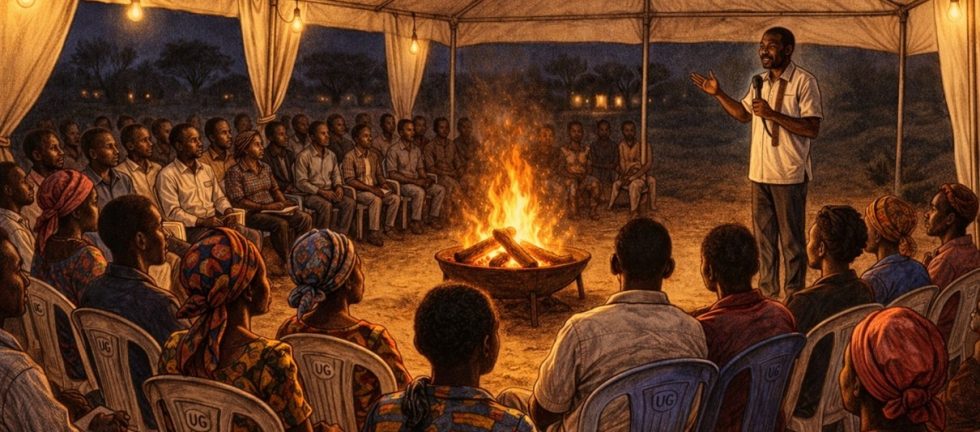
Welcome to the Fork in the Road Blog: Reflections on Life. These are “fireside” musings on the reasonably long life I have lived so far. It is my way of thinking aloud over everyday issues, reflecting on life’s “What”, “Why?” and “How?” and sharing my views with people around me, physically and virtually. The musings are, however, primarily for my wellbeing. They are therapeutic. They keep me mentally alive. The topics I muse over come to me haphazardly triggered by the surroundings or interaction with people or purely out of the blue.
As I have aged (become quite old) I cannot stay long at vigils, let alone spend a night by the fireside, however much I may be mourning the deceased. This transition, brought on by age, made me look back at the numerous vigils I have attended and start reflecting on this social activity.
A vigil is a gathering in which people remain awake, attentive, or present for a period to mark an event, express solidarity, mourn, pray, or protest. Across the world, vigils appear in many different cultural ways, but they share a common idea: collective presence in a moment of reflection or concern.
In the country I know best (as they say in the United Nations meetings) vigils are associated with death only. In other societies vigils are also used as peaceful forms of protest. People may gather silently or with candles to call attention to injustice. Examples include human rights vigils, environmental or peace vigils or justice vigils after incidents of violence. These are peaceful demonstrations of dissent providing silent and reflective moral weight without confrontation.
While vigils around the world share underlying common elements of remembrance, silence or talking in low tones and prayer, vigils in Africa, and particularly in Uganda, have distinctive cultural and social characteristics reflecting strong communal traditions, religious (in a very broad sense) influence, and social support in the time of mourning.
In Uganda people are informed of a vigil not invited to a vigil. A vigil is not just for close family but for the whole community. It is a collective act of solidarity where the community literally keeps watch with the bereaved family reflecting the African concept that sorrow is shared rather than carried privately.
Vigils are global civic rituals regardless of culture, religion, or nationality. People instinctively gather to say: we remember, we care and we stand together. Despite cultural differences, many vigils share common symbols such as silence demonstrated by mere presence; fire lighting (candles, logs etc.) representing hope, remembrance, or life; laying flowers or items representing the life of lives of the people being remembered; prayer for reflection; nighttime gatherings symbolizing watchfulness; telling stories of the deceased keeping memory alive. These symbols make vigils emotionally powerful across cultures and universal human response to loss, injustice, or hope for change.
In Uganda, people stay through the night, sometimes for several nights, before the burial takes place as a sign of respect and support for the family. Conversation, prayer, and storytelling about the deceased may continue through the night. The vigil therefore becomes both spiritual and social. We share memories of the deceased telling positive stories about the person’s life, character and contributions to the community. These events are also opportunities of meeting friends and colleagues we may not have seen for some time. Vigils help strengthen communal bonds. In Uganda and much of Africa, vigils are therefore more than a quiet memorial. They are communal acts of watchfulness, prayer, remembrance, and mutual support, where grief, tradition, faith, and community life come together.
Practical solidarity is a distinctive feature of vigils in Uganda through contributions of money for funeral expenses, providing food for those gathered and organizing burial logistics. Thus traditionally, the vigil is not only symbolic; it is also a mobilization of community help.
Psychologically, vigils serve several human needs: collective grieving, solidarity with victims or causes, public acknowledgment of suffering, moral witness etc. They allow communities to be one in grief or concern.
Vigils can be a space for moral reflection. They are often seen as an opportunity not to be missed by preachers to remind the captive gathering to reflect on their moral and spiritual lives reminding them the brevity of life, the importance of reconciliation and living responsibly within the community.
Vigils are moments when we stand together in grief, hope, or solidarity. In communities in Uganda and beyond, vigils reflect our shared humanity and our instinct to support one another in times of need. At their best, they are deeply human forms of expression. But like any gathering, especially one shaped by emotion and a sense of shared obligation, they can be susceptible to misuse.
While many of these issues are global, certain behaviours are more pronounced in African settings due to cultural and socio-economic realities. For example, vigils lasting several nights are likely to lose focus become a burden to the bereaved family, financially and physically, and mourners who feel obliged to attend.
Although communities rally strongly and freely around bereavement, repeated vigils and expectations of contribution can be a financial burden. Cash collections, with minimal record-keeping are open to misuse of funds, and erosion of trust by well-wishers (mourners). When a vigil becomes a place of obnoxious fundraising, it risks turning a captive and emotional gathering into an opportunity for pressure rather than compassion. Unscrupulous people may appeal to grief to encourage non transparent donations instead of clearly explained purpose of funeral costs, collections may be vaguely justified. Funds collected in informal settings may not be documented, audited, or transparently used, opening room for lack of accountability. When accountability is lacking, trust, the very foundation of inter-personal and community bonding, is eroded.
As a Rotarian, guided by the spirit of service and the Four-Way Test, I might ask:
- Is it the truth? In other words, “Are the needs and uses of funds clearly stated and related to the purpose of the gathering?”
- Is it fair to all concerned? “Are people free to give without pressure?”
- Will it build goodwill and better friendships? “Does the vigil unite or divide?”
- Will it be beneficial to all concerned? “Are both the bereaved and the community truly served?”
A vigil should remain a gathering of sincerity, not strategy, of compassion, not compulsion.
In guarding its integrity, we preserve not only the dignity of the occasion, but also the trust that binds us together as a community of service.
Other negative elements of vigils include turning them into platforms for political messaging or mobilization, sometimes shifting focus away from the original purpose of mourning and reflection. With the rise of social media, some vigils become more about self-promotion (photos, public image) than genuine engagement. And when the focus shifts from reflection to self-display, from service to self-interest, the dignity of the moment is diminished.
Despite these possible negatives with vigils, it is important not to lose sight of the positives: vigils remain powerful expressions of community, empathy, and shared humanity. Unfortunately, the same closeness that makes them meaningful also makes them vulnerable to trust replacing accountability and social obligation replacing personal freedom.
Thank you for being part of the Fork in the Road Blogs: Reflections on Life. Be sure to look out for the next episode when I will be writing about Head covers. If you gathered something useful, please feel free to share the blog. My books, Fork in the Road: Creating a future of value starting from where you are and A view round the bend. Setting goals for your life’s journey are available for purchase at Aristoc bookshops in Kampala, Uganda and online at Amazon.
Your comments on my musings are most welcome and let me know whether there is a topic you would like me to muse over.
Comments (6)
Muhumuza John Kakitahi
Mzee Lwanga, I’m reflecting on how “mourners” (and others) are informed of vigils and not invited! Typical to our settings. However, I have particularly been delighted in your use of Rotary’s Four-Way test in evaluating a norm of society. #Blessings.
Stephen Lwanga
Thanks, John. I find the 4-WT so positively encompassing similar to the Jesus’s “Love your neighbour as you love yourself”
shem Nnaggenda Nsubuga
Mmmmm, quite a bit of reflection here. Have u written out how your vigil will be conducted or played out ? How your funeral ceremonies will be conducted and by who? Where your condolence gifts will be governed?
Funeral vigils are always a great way to reflect on the life of a departed, to share the grief and make it manageable. Sometimes a way in which informality reveals more about the departed in death than the formal funeral service and burial ceremony. Vigils should be celebrated
Stephen Lwanga
My family has an idea of how I would like to be sent off. I am fully mindful that I will not be part of the goings on. It is their affair, but my guidance is for their good during what, I hope, will be a difficult time.
Vigils should be a time of celebration. Thanks, Shem, for the comments as usual. Your comments make me reflect more on m musings.
Yiga Robert
Wow, here reflecting on the vigils of those days and now. Didn’t realize that a vigil is not only for mourning but it can be a powerful weapon to fight injustice. Like you have there is need for Society to keep vigils the way they used to be.
Stephen Lwanga
Thanks, Rtn Yiga for the comments. Yes, vigils are moments of reflection.