
Welcome to the Fork in the Road Blog: Reflections on Life. These are “fireside” musings on the reasonably long life I have lived so far. It is my way of thinking aloud over everyday issues, reflecting on life’s “What”, “Why?” and “How?” and sharing my views with people around me, physically and virtually. The musings are, however, primarily for my wellbeing. They are therapeutic. They keep me mentally alive. The topics I muse over come to me haphazardly triggered by the surroundings or interaction with people or purely out of the blue.
I started paying attention to head covers when I was musing over Hair as I looked at shaven heads and wondered how they felt, in the scorching sun, without a head cover. My wandering mind went beyond the effect of the sun and shaven heads.
In health care, head coverings, such as surgical caps, are part of infection control protocols rooted in principles of disease-free techniques. We are continually shedding hair which, we are told, carry microscopic organisms. Health workers are supposed to cover their heads to reduce the risk of introducing bacteria into the patients’ spaces. This should be standard operating procedure (SOP) in all health facilities especially in sterile environments like operating theatres or when dealing with vulnerable patients.
A covered uniformed health worker signals professionalism and reassures patients. The head cover presentation projects competence and safety, key elements of trust in medicine. Unfortunately, some head coverings are more symbolic than functional. In health facilities across the country, head coverings by nurses are part of clinical dress uniform but are worn without regard to their intended purpose of guarding against hair contamination.
There are several head coverings used for medical and health-related purposes. Unlike cultural or symbolic headwear, they contribute to the wellbeing of the wearer. They enhance comfort and dignity for people reacting to treatment such as hair loss due to cancer therapies and provide psychological well-being, restoring confidence and dignity.
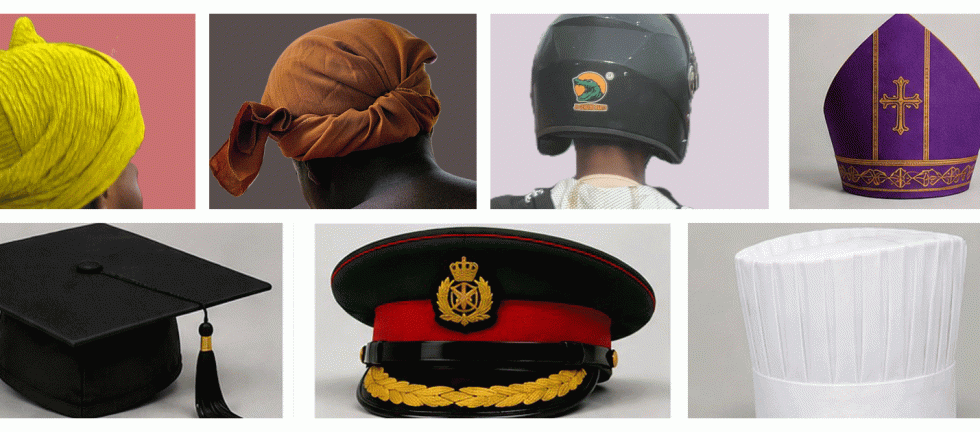
Several religions have requirements for covering the head. The caps, hats, and other head coverings worn by church leaders are not merely decorative, however comical looking some may be. In many Christian traditions, especially within the Catholic Church, Eastern Orthodox Church, and some Anglican and Protestant churches, they symbolize authority, office, humility, spiritual responsibility, continuity with tradition, and sometimes vows or theological ideals.
As my mind roves over selected religious sects, I have found that, in Christianity those who cover their heads for prayer take it from Saint Paul’s teaching, in 1 Corinthians 11, where he addresses proper conduct in worship, including head coverings as a sign of humility and reverence.
In Islam, coverings like the hijab, niqab, or khimar are linked to ideas of modesty and obedience to God. Some see it as a personal spiritual choice or as a visible marker of Muslim identity.
In Judaism, men wear a skullcap as a reminder of God’s presence. Married women in Jewish Orthodox communities cover their hair with scarves, hats, or wigs as a marker of modesty and marital status.
The turban is not optional for practicing Sikhs. It is a core article of faith tied to dignity, equality, and spiritual discipline. It also protects uncut hair, which is one of the key tenets of Sikh identity.
The Rastafarian hat, or the rastacap, in the red, gold, green and black colours, is worn to protect dreadlocks and express spiritual identity. The colours carry deep symbolic meaning rooted in Rastafarian spirituality, Ethiopian history, and Marcus Garvey’s Pan-African movement.
Marcus Mosiah Garvey Jr. was a Jamaican nationalist who believed that black people worldwide should reclaim their heritage and assert their rights with pride and Black Nationalism and Self-Determination confidence. He advocated for the creation of independent black nations and institutions, emphasizing self-sufficiency rather than integration into predominantly white societies.
Academic headgear, those caps, hoods, and sometimes elaborate hats worn at graduation ceremonies are visual symbols of scholarship, tradition.
Colours and designs indicate fields of study and academic rank making them a coded language of intellectual specialization and academic hierarchy. The mortarboard is common for undergraduate and master’s degrees while the tam (soft round cap) is typically worn by doctoral graduates. When I see 6-year-olds transitioning from pre-school to formal education dressed up in academic regalia I wonder what all that hullabaloo means.
Beyond achievement, academic headgear signals membership in a scholarly community. When worn by faculty during ceremonies, it also conveys authority and stewardship of knowledge The first time I wore a mortarboard I felt as if I had joined a lineage of learning both in recognition and responsibility.
Traditional or cultural head gear, crowns, headdresses, and ceremonial caps, are not just functional or fashionable items; they carry deep social meaning, identity, and often authority. They may come in all designs, ranging from visibly cheap home productions to jewelled artworks. Whatever form they may be in, they represent office, institutional continuity, and the sacred trust of leadership signifying authority and legitimacy. They are, in essence, the pinnacle of symbolic head coverings. Unlike purely functional or fashion items, they carry deep, often inherited meaning, linking the individual not just to a role, but to a community, a history, and a system of values.
Where head coverings are used in specific rituals or life events, they symbolize those events e.g. transition from youth to adulthood if won during circumcision or connection to ancestors for funeral rites etc.
While some head coverings have little or no deep symbolic meaning, it does not mean that they are purposeless. While helmets and hard hats are won for safety, hairnets, shower caps chef’s hats for hygiene and swim caps for performance, they have no meaning beyond their practical purposes. They have no symbolism but may convey subtle contextual importance even when the covering is “meaningless” by design. A baseball cap worn backwards might suggest youth identity. A head scarf might become cultural depending on how it’s worn. In Uganda, where clothing often intersects with identity, even ordinary items like head covers can acquire social or cultural nuance over time.
There are, therefore, head coverings with no inherent or traditional significance, especially those made for social functions or casual fashion for informal, temporary, or personal meaning.
Head coverings (hairnets, caps, or chef hats are central to food hygienic standards in food preparation and service. Prevention of hair contamination is one of the most basic sanitation requirements. Customers expect visible hygiene practices and completely covered heads of caterers, even bold headed ones, gives the impression of cleanness in the kitchen. From high-end hotels to some roadside food vendors, head coverings reflect conscious attention to food hygiene.
In Ugandan homes, especially in rural settings, it is common for those preparing meals to cover their hair probably to protect it from soot or soak up sweat. Irrespective of the reason for covering the head, food preparation is treated as a respectful act of service, not a casual task. Sharing food is central to Ugandan hospitality; ensuring its cleanliness is therefore a matter of honour.
In security services: police, military, and private guards, headgears such as caps or berets carry strong symbolic weight. Head covers provide a clear identification of officers from civilians. A headgear with uniform is supposed to project order and legitimacy. A beret or cap is not just worn, it is earned, often marking rank, unit, or achievement. Helmets, on the other hand, protect against head injury.
The uniform cap distinguishes the individual as a custodian of public order. When it does not, there is a sense of betrayal. We see, almost daily, the desecration of what is supposed to be a symbol of order and security.
Across all these professions headcovers communicate safety, cleanliness, and authority and they project a disciplined system. Headgear instantly identifies the role of the wearer be it a chef, religious leader, security agent, judicial official, academic don, royalty, traditional or cultural leader.
Head coverings in professional life echo a wider human pattern: what we wear on the head often represents what we carry in responsibility. The wearer is expected to behave differently when wearing it. In that sense, a bishop’s mitre, nurse’s cap, a soldier’s beret, and a chef’s hat all say something similar: “I am accountable for what happens under my care.”
So, whether in a surgical theatre at a health facility, a checkpoint at a highway, or a kitchen in a small town, I would like to receive a consistent message when I see the wearer of a headgear: “I am entrusted, with life, with order, or with your well-being, and I must be worthy of that trust.”
What message does a shaven head dripping of sweat in a scorching sun give? A silent plea for a cover? Or what message is conveyed by a motorcyclist’s helmet hung on the handlebars of the motorcycle?
Thank you for being part of the Fork in the Road Blogs: Reflections on Life. Be sure to look out for the next episode when I will be writing about Motivation. If you gathered something useful, please feel free to share the blog. My books, Fork in the Road: Creating a future of value starting from where you are and A view round the bend. Setting goals for your life’s journey are available for purchase at Aristoc bookshops in Kampala, Uganda and online at Amazon.
Your comments on my musings are most welcome and let me know whether there is a topic you would like me to muse over.