

Welcome to the Fork in the Road Blog: Reflections on Life. These are “fireside” musings on the reasonably long life I have lived so far. It is my way of thinking aloud over everyday issues, reflecting on life’s “What”, “Why?” and “How?” and sharing my views with people around me, physically and virtually. The musings are, however, primarily for my wellbeing. They are therapeutic. They keep me mentally alive. The topics I muse over come to me haphazardly triggered by the surroundings or interaction with people or purely out of the blue. The topic “Beyond the merchandize” came to me while sitting in my vehicle, stuck in a traffic jam, and surrounded by street hawkers selling all sorts of merchandize ranging from ripe bananas to imported products, most likely made in China. I suddenly realised that I had been looking at these items without seeing them.
As an old man’s rambling, I take liberty with word usage. Merchandize in this rambling refers to more than produced items or things for sale. I am also using it to refer to people handling the products.
I live in a city teeming with street hawkers and homeless kids. The hawkers sell fruits, vegetables and imported cheap items. Very often buyers look at the items that interest them, negotiate the price and either buy, or do not buy any, and move on. Looking beyond the item on sale is to recognize that every product carries an unseen story. What we see, a finished object, represents only the final step of a long chain of human effort, natural resources, creativity, and other circumstances. This viewpoint encourages greater empathy, responsibility, and conscious consumption.
When we reflect on the journey of any object, we think of the origin of the items, if manufactured we think of craftsmanship. We think of the economic and ethical dimensions behind their production and the journey up to the point our paths cross.
Every item we buy is either cultivated or made (manufactured). For edibles, such as fruits and other food items, I can’t help asking myself where they came from, the production and trading hands they would have gone through up to the point I am looking at them. Therefore, looking beyond the item, begs the question of who produced them. It may be the physical labour or craftsmanship. If it is physical labour, I think of the conditions under which the work was done. For craftsmanship I think of the skills and mental thinking that went into transforming raw materials into a finished product.
When I turn my mind to economic and ethical dimensions, I think of the production cost, and the number of people who participated in bringing the item to the market. I think of whether they were fairly compensated for their labour and the circumstances that determined the prices at source and the journey’s end. Judging from the price of the produce I sympathetically wonder how much the farmer was paid.
We are consciously and continually addressing the impact of our actions to climate change although, I must admit, I do not fully understand all the scientific arguments. But as I look beyond the produce or product, I reflect, as a layperson, on the energy or chemicals used and the impact the material will have after its useful life.
Sometimes I wonder whether the items being sold by hawkers were acquired legitimately or not. That is another story.
Behind every seller is a personal narrative influenced by struggle, history, challenges etc. Many women are either carrying babies on their back or are visibly pregnant. In essence, when looking at a produce or a product, it is not just an object, it is a story of nature, labour, culture, economics and environment and personal circumstances.
We can assume that every trader, large or small, is trading to make money. The differences are whether the money is to make “ends meet” i.e. for survival or they are pursuing private enterprise as a trade. The primary purpose of working to make ends meet is immediate survival for food, shelter etc. Income is for consumption not to be accumulated. Decisions are short-term, reactive and driven by urgency and necessity. Whereas aim of private enterprise as a trade is value creation and growth with income partly reinvested to expand capacity, and profitability. Decisions are long-term, strategic and involve planning, patience, and delayed returns.
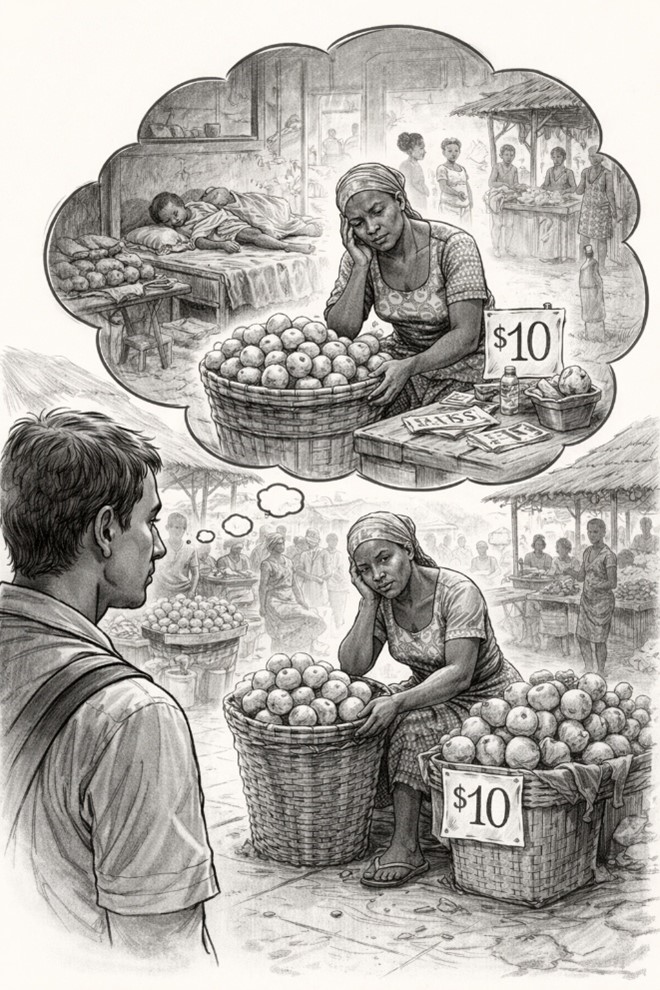
When I see women (they are normally women in Kampala) hawking produce, fruits and vegetables and look beyond the individuals in front of me, I wonder what social structures, or circumstances drove them into the job they are doing. They may be escaping from abusive partners, or school dropouts or misguided in having thought that life would be better in town and took a chance leaving their rural homes. The majority are likely to be single mothers supporting families, funding education. Working to make ends meet.
I love hand woven rugs and carpets usually made of wool such as the Bokhara rugs and carpets originally from Uzbekistan but are now made in Pakistan. Years ago, I was in Pakistan and visited a carpet production facility. I was astounded to find children as young as seven years working at the looms hand weaving the rugs and carpets. The supervisors were probably eighteen years old but with over ten years’ experience. These children were not going to school, and I could only guess how much they were paid. I knew the value of their products on the open market because I had bought them. I was saddened by what I saw and could not bring myself to buy any rug at the factory.
All my working life I have tried to find satisfaction in what I do and feel dignity in doing it. Looking beyond the street sellers sometimes I say to myself that “there I am on the street as a hawker but by the Grace of God” and wonder how they feel doing what they do. There are research papers reporting on the economic contributions of street sellers, but not all these papers address the social issues that come with the job. They do not ask whether the street sellers find dignity, pride and hope in what they do or frustration and dejection by family and society. I believe most hawkers had no alternative options for survival.
Looking beyond the produce and the seller, we develop empathy toward the person and make more ethical choices for example how much bargaining over price or whether to buy or not to buy the item. With empathy we recognize the dignity of the sellers at all levels. It also helps us reflect on the exploitation in supply chains and marketplaces. To look beyond the material or the seller is to acknowledge the long, often invisible, journey of resources, labour, circumstance, and humanity that brings any object into our hands and the roles played by many people.
As a Rotarian, I try to uphold dignity in all human interactions (I may not succeed all the time, after all I am human). When I engage with sellers, I encounter not just goods, but people, not just transactions, but lives. I acknowledge that every material has travelled a long journey or shaped by many hands. Every seller has a background shaped by effort, circumstance, and ambition. To look beyond the item is to recognize our shared humanity. To look beyond the sellers is to acknowledge their struggles, dreams, and strength.
The Four-Way Test is an ethical guideline used by Rotarians worldwide, consisting of four questions that help individuals evaluate their thoughts, words, and actions. These questions are easily applicable to my topic, looking beyond the product and its handler. The questions are:
- Is it the truth?
When we look at a product, the truth is that it carries a hidden journey, of labour, and sacrifice. As for the sellers, the truth is that they have a life influenced by challenges, choices, and hopes. Realizing this truth deepens our humanity.
- Is it fair to all concerned?
Fairness begins with treating people with dignity. It is proper or fair to acknowledge the dignity of those whose work brings value into our lives. It means treating sellers and workers, not as instruments of convenience, but as people deserving justice, respect, and equitable treatment.
- Will it build goodwill and better friendships?
When we look beyond the material and see the person, with empathy rather than judgment or disdain, we create room for goodwill.
- Will it be beneficial to all concerned?
Benefit becomes meaningful when it uplifts everyone in the chain, producers, sellers, buyers. When we honour the story behind the sale, we promote choices that support livelihoods, encourage ethical practices, and strengthen our shared well-being.
The Four-Way Test invites us to look deeper, beyond what is visible, beyond what is convenient, and beyond what is merely transactional. Whether we are buyers, sellers, service providers, or simply citizens in a busy world, every interaction gives us a chance to practice the Test in its truest spirit, not just the transaction, but the humanity within it.
The moral of this musing is simple: honour the invisible journey of the people you are dealing with and their merchandize, and you uplift your human spirit behind every exchange. Behind each item is a journey of production and people who brought it to the market. To look only at what is visible is to miss the humanity woven into the unseen. The true measure of value lies not only in the material itself but includes the lives, labour, and expectations silently attached to it. When we learn to look beyond the product and see the person handling it, beyond the transaction and see the story, we cultivate empathy, respect, and responsible living.
Thank you for being part of the Fork in the Road Blogs: Reflections on Life. Be sure to look out for the next episode when I will be writing about New Year’s resolutions. If you gathered something useful, please feel free to share the blog. My books, Fork in the Road: Creating a future of value starting from where you are and A view round the bend. Setting goals for your life’s journey are available for purchase at Aristoc bookshops in Kampala, Uganda and online at Amazon.
Your comments on my musings are most welcome and let me know whether there is a topic you would like me to muse over.
Comments (4)
shem Nnaggenda Nsubuga
Indeed, empathy should be exercised while interacting with those less fortunate, but who are lifting themselves up. Its a daily challenge whilst meeting a street vendor or hawker to emulate the true Rotary spirit!
Rtn Stephen
Good observation Rtn Shem. I find it a challenging experience thinking beyond the people and items in front of me.
Miriam Nagadya
Beautifully articulated: “The true measure of value lies not only in the material itself but includes the lives, labour, and expectations silently attached to it. When we learn to look beyond the product and see the person handling it, beyond the transaction and see the story, we cultivate empathy, respect, and responsible living.”
Rtn Stephen
Thank you and do the same.